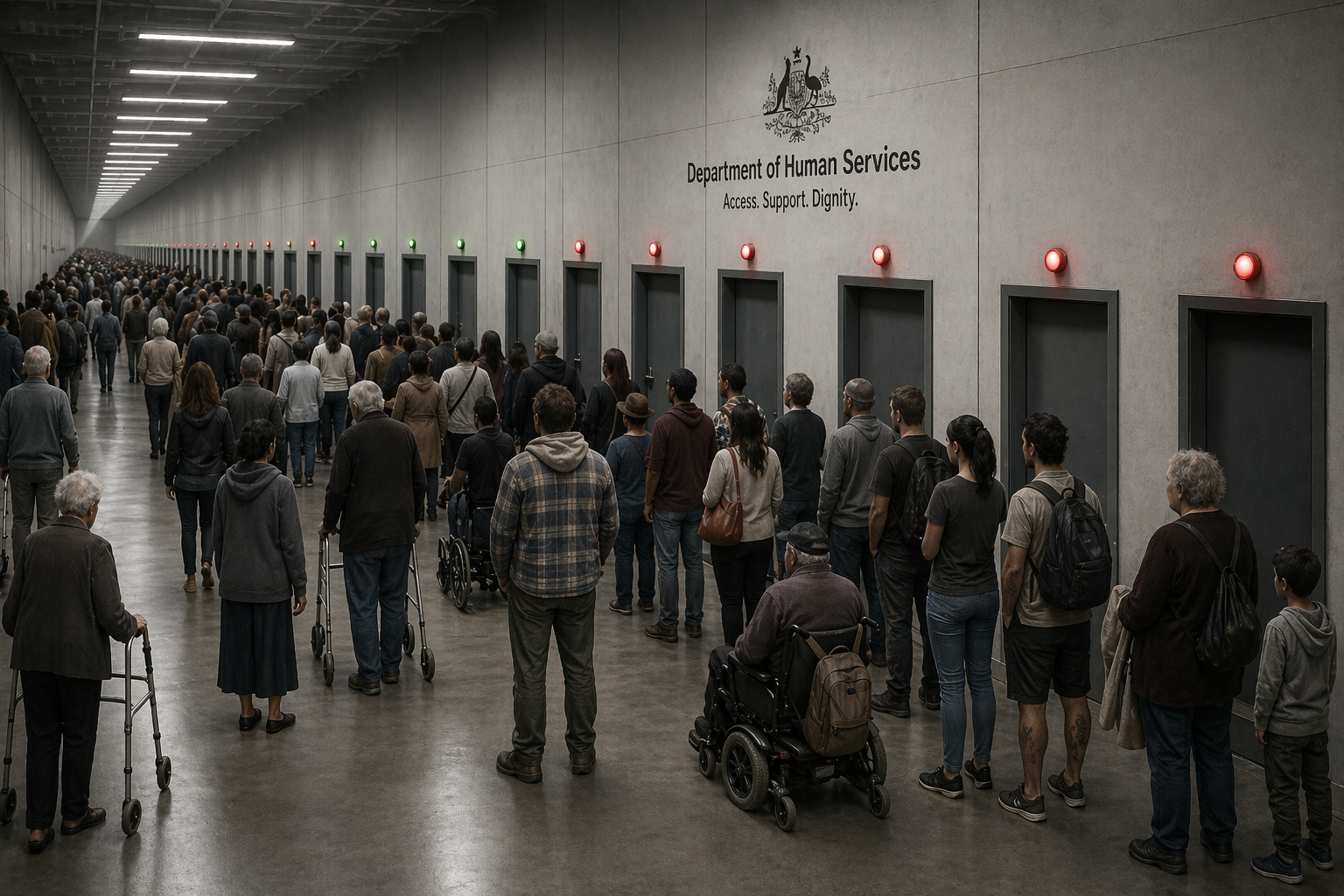
Why the NDIS Cuts Are a System Design Failure
When I’m asked to build a new system at work, I start with estimates. How many users am I expecting? What load will it need to handle? I design accordingly, no point over-engineering something that doesn’t need it yet. If my SLA says I need to respond in two seconds and I can achieve that with my expected user base, spending extra time optimising is actually wasteful. It delays delivery without adding value.
But what happens when the system goes live and the demand is way beyond what I anticipated?
I have two options.
Option one: dig into the system, find what’s costing the most, and optimise for the actual load. Find the inefficiencies, remove the bottlenecks, make it work better for more people.
Option two: implement a rate limit. Once a certain number of users have accessed the system, cut the rest off.
In software engineering, option two is a terrible solution. It’s lazy. It’s harmful. It doesn’t fix anything it just makes the overflow invisible by turning real users into error messages.
And yet option two is exactly what the Australian government has just announced for the NDIS.
760,000 Australians currently rely on the scheme. The government’s solution to unexpected demand isn’t to find the inefficiencies, address the root causes, or optimise how the money is spent. It’s to rate limit. Cut 160,000 people off by 2030. Slash average plan amounts from $31,000 to $26,000. Reduce annual growth from 10% to 2%. 1
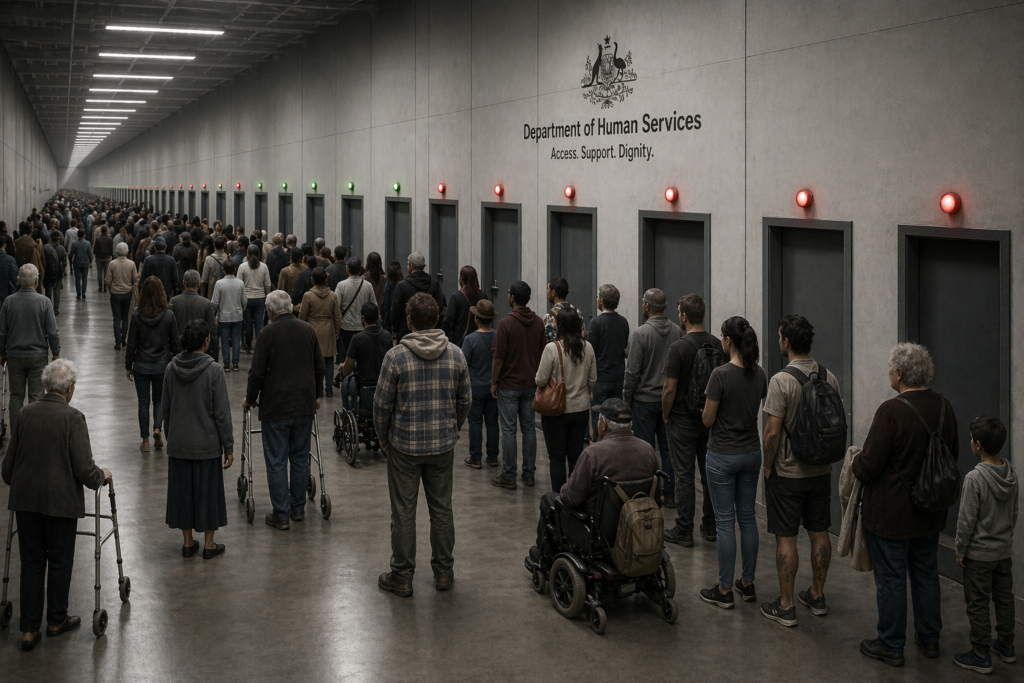
Turning real people into error messages.
Why the Numbers Were Always Going to Be Wrong
The NDIS was originally designed around a specific understanding of disability: visible, permanent, binary. You are disabled or you aren’t. You have a diagnosis or you don’t. You belong in the scheme or you don’t.
In my experience, this is not how disability works.
For many conditions, there are periods where a person can manage life with minimal disruption and periods where they cannot perform basic functions of self-care. Disability fluctuates. It responds to environment, stress, access to support, and a dozen other factors. A person with Multiple Sclerosis might be largely independent for months and then completely unable to care for themselves during a relapse. Someone with severe depression might hold down a job for a year and then be unable to get out of bed.
The binary model doesn’t capture any of this. So the original estimates were built on a flawed foundation.
Now, one of the proposed changes is to move away from diagnosis-based access lists toward standardised assessments of functional capacity. And honestly? Out of everything announced, this is the least bad idea and potentially a good one.
Here’s why: two people with the same diagnosis can have completely different lived experiences. Two people with ALS, two people with autism, two people with chronic pain etc, putting them in the same funding bucket because their medical label matches is crude at best, harmful at worst. What actually matters is what they can and can’t do. What support they need to participate in their own life.
Functional capacity assessments, done well, could actually capture that nuance.
But here’s the paradox: I think this change is going to increase costs, not decrease them.
Because right now, people are forced to bend their diagnosis to fit the system. Not because they’re rorting it, because it’s the only way in. The system has a narrow door, and the only key that fits is a recognised diagnosis. So people who desperately need support based on their functional reality spend years and thousands of dollars chasing a medical label that unlocks access.
If you open that door to functional capacity instead, you’re going to find a lot of people who genuinely need support but couldn’t previously prove it on the system’s terms.
And the fraud narrative? The government loves to imply the scheme is being rorted. The actual data shows 0.54% of NDIS participants were found to have committed fraud in 2024, and that’s with “insufficient evidence” 2. I’d argue the majority of that tiny percentage are people who need support based on their capacity but couldn’t access it any other way. That’s not fraud. That’s a system design failure forcing people into corners.
Why Demand Exploded: The Causes Nobody Wants to Talk About
The government’s narrative is simple: the NDIS grew beyond its original intent, people are accessing it who shouldn’t be, and costs are out of control. Cut the numbers, cut the plans, problem solved.
But this completely ignores why demand exploded. And if you don’t understand why demand grew, cutting people off doesn’t fix anything. It just moves the suffering somewhere less visible.
There are three causes the government refuses to meaningfully address.
The Healthcare Failure
Australia’s general healthcare system is failing ordinary people. Bulk billing is increasingly rare. Waiting lists for psychology, physiotherapy, occupational therapy, and speech therapy are months long, often years. For people who can’t afford private rates, these services are effectively inaccessible.
For disabled Australians, who have significantly lower employment and income participation rates than the general population, private healthcare isn’t an option. The NDIS becomes the only pathway to access services they need just to function.
If psychology was genuinely accessible to every Australian who needed it, NDIS plans wouldn’t need to fund it. If occupational therapy was available through the public health system, it wouldn’t need to come out of a disability support budget. The NDIS is partially a band-aid over a healthcare system that has been systematically defunded and privatised.
Fix the healthcare system and NDIS demand drops. Don’t fix it and cutting people off the NDIS doesn’t make their need for support disappear, it just makes it someone else’s problem.
COVID-19 Is a Mass Disabling Event
The government doesn’t want to talk about this. But the data is clear.
Approximately 4% of adults experience ongoing long COVID symptoms. Of those, around 25% report significant limitations on their ability to work and participate in daily life. 3 4 We are also seeing a spike in early onset diseases, cancers, autoimmune conditions, neurological disorders, that researchers increasingly link not to microplastics or lifestyle factors, but to repeated COVID-19 infections and the cumulative damage they cause.
COVID doesn’t just kill people. It disables them. Quietly, chronically, permanently in many cases.
And the government’s response? No public education about ongoing risk. No meaningful air quality mandates. No acknowledgment that children repeatedly infected from infancy (some exposed from the womb) may face long-term neurological and developmental consequences we are only beginning to understand.
We are creating disabled people faster than the NDIS can accommodate them, and then blaming the scheme for growing.
The Children’s Support Crisis
There’s a lot of noise about the “autism explosion” and what it means. Some of it is genuine: we have significantly better diagnostic understanding now, particularly for girls and women who were historically ignored or misdiagnosed by a medical community that built its understanding of autism almost entirely on male presentations.
But autism isn’t the only story. Dyslexia, dysgraphia, sensory processing disorders, developmental delays, anxiety, there is a whole spectrum of conditions affecting children that require support to allow them to learn, develop, and participate.
Here’s the problem: the NDIS is currently the only meaningful pathway to access that support. There is no parallel system for children who need help but don’t meet the NDIS threshold. So parents do what any parent would do, they find the pathway that works. Autism is often the quickest and most accessible entry point into the scheme.
Is that bending the diagnosis to match the capacity? Sometimes. But whose fault is that? Not the parents desperately trying to get their child support. The fault lies with a system that created one narrow door and then acts surprised when everyone tries to squeeze through it.
Build proper support systems for children outside the NDIS, and watch the numbers change.
Now we get into where the money is actually going:
Where the Money Is Actually Going
So if the government is serious about reducing costs without cutting people off, where should they look?
The answer is right in front of them. They just don’t want to say it out loud because it requires confronting something ideologically uncomfortable: privatisation is bleeding the scheme dry.
The NDIS was designed to fund support for disabled Australians. But somewhere between the government’s budget allocation and the disabled person receiving support, a significant chunk of that money is being extracted by for-profit providers. Not delivered as support. Extracted as profit.
Let me give you a concrete example.
A participant needs help with lawn maintenance so they can maintain their home and remain employed. Their plan allocates two hours of support per quarter, eight hours a year. At the NDIS approved rate of $120 per hour, that’s $960 annually. That sounds like a lot for eight hours of lawn mowing.
But speak to the person who actually shows up and mows the lawn. They’re being paid $40 an hour. One third of the billed amount. The other $80 per hour (two thirds of the total cost) goes to the provider.
Some of that covers legitimate overhead: insurance, compliance, scheduling, administration. But the provider also needs to be profitable. So a portion of every hour billed goes not to the disabled person, not to the worker, but to shareholders.
Now multiply that across 760,000 participants. Across carers, meal preparation, cleaning, transport, therapy support. Across every service delivered by a for-profit provider taking a significant margin on every hour billed.
The inefficiency isn’t disabled people accessing the scheme. The inefficiency is profit extraction at industrial scale.
The solution isn’t complicated. For high-volume, standardised services,lawn maintenance, cleaning, meal preparation, personal care, the government should establish a baseline public provider. Hire workers directly. Full time employment with benefits, not gig economy casualisation exploiting migrant labour. Deliver the service at cost, without a profit margin sitting on top.
The disabled person still gets their eight hours of lawn mowing. The worker gets a stable, fairly paid job with leave entitlements and security. But the $80 per hour that was going to a provider’s bottom line? That stays in the scheme.
Private providers don’t disappear. They still exist for specialist, bespoke, or complex needs. But they now have to compete with a government baseline offering, which immediately drives down the inflated rates.
The same logic applies to disability aids and equipment.
Before I had any personal connection to the NDIS, I had no idea what disabled Australians pay for basic equipment. A shower chair. A wheelchair cup holder. A bed rail. Items that cost $15 at Kmart or Bunnings are listed at $90 to $150 through NDIS approved disability suppliers. Sometimes the markup is twenty times the retail price for an identical item.
The government should be designing and bulk purchasing standard disability equipment centrally. Wheelchairs, walkers, adjustable beds, chair lifts, bathroom aids, the items used by tens of thousands of participants. Order them in volume. Distribute them centrally. Drive the cost down through scale.
Scotland has taken this further, mandating local procurement wherever possible. The result: lower costs for the scheme, support for local manufacturing, and jobs created in the community. Australia could do the same.
Private suppliers still exist for custom, complex, or specialist equipment. But for the standard items used by the majority of participants, bulk procurement through a central government model would save hundreds of millions of dollars without removing a single person from the scheme.
This is where the $70 billion is going. Not to disabled people living lavishly. Not to widespread fraud. To profit margins on lawn mowing and twenty times markups on shower chairs.

The NDIS Isn’t a Cost. It’s an Investment.
Every time the NDIS budget comes up in public conversation, it’s framed the same way: as a burden. A drain. An unsustainable expense that responsible government must bring under control.
This framing is wrong. And the data shows it.
Studies show that for every dollar invested in the NDIS, approximately $2.25 comes back into the Australian economy 5. For a scheme the government wants to paint as financially reckless, that’s a remarkable return on investment.
But how? It seems counterintuitive. You put money in and get more back?
Think about what actually happens when NDIS funding flows into a community.
The lawn care worker who services NDIS participants now has stable, full-time employment. They pay income tax. They spend their wages at local businesses. They don’t need unemployment benefits or housing assistance. One funded support role creates economic activity well beyond the hour of lawn mowing.
And it’s worth acknowledging who those workers often are. NDIS support roles (carers, cleaners, meal preparers, community support workers) tend to attract people who struggle to find employment in traditional structures. People who can’t commit to rigid nine-to-five schedules due to their own health conditions or caring responsibilities. People who need flexible, community-based work that fits around the complexity of their lives. People who are themselves economically marginalised and for whom a casual support role is the difference between participation and welfare dependency.
Private providers exploit this vulnerability. Casualised hours, unpredictable income, no job security. That’s the gig economy at its worst. But done properly, through direct government employment with stable hours, fair wages, and real entitlements, these become genuinely good jobs for people who need them most.
And then there’s the family carer dimension, which almost never gets talked about.
Many disabled Australians aren’t supported by strangers, they’re supported by partners, parents, siblings, adult children. When NDIS funding is adequate, a family member can remain in the workforce while a paid support worker fills the gaps. Two people contributing to the economy, paying taxes, maintaining their careers and financial independence.
Cut the NDIS support and watch what happens. The family carer has no choice but to leave work entirely to fill the void. Now you’ve lost two workers from the economy instead of one. Two people potentially dependent on government support instead of none. The “saving” on the NDIS plan doesn’t disappear, it just relocates to carer payments, lost tax revenue, and the long term economic and health consequences of unpaid carer burnout.
The NDIS, properly structured, doesn’t just support disabled Australians. It keeps families in the workforce, creates employment pathways for economically marginalised workers, and generates economic activity that flows directly back into local communities.
The disabled person whose home is maintained can now remain employed. They pay income tax. They contribute superannuation. They spend their income locally. Without that support, they might lose their job, their housing, their independence, and become far more expensive to the system through healthcare, emergency services, and welfare.
And nowhere is this long-term return more stark than in early childhood intervention.
When a child receives adequate support early, speech therapy, occupational therapy, developmental support, behavioural intervention, the trajectory of their entire life changes. A child who learns to communicate effectively, regulate their emotions, and participate in mainstream education at age four doesn’t need the same level of intensive support at age fourteen, or forty. Early investment compounds. Every dollar spent supporting a child’s development in their first years of life can return many times over across decades of greater independence, employment participation, reduced healthcare needs, and lower reliance on government support.
Cut early intervention funding to save money today and you don’t eliminate the cost. You defer it, multiply it, and distribute it across health, welfare, justice, and social support systems for the next fifty years. The child who didn’t get support at four doesn’t disappear from the budget. They just show up somewhere more expensive, much later.
Even disabled Australians who can’t work are economic participants. Being able to access the community means being able to spend money in it. The local shops, the local services, the local economy. NDIS funding doesn’t sit in an offshore account or get distributed to wealthy shareholders. It flows directly into the hands of people who spend every dollar of it locally, in the communities where they live.
Compare this to where else government money goes.
AUKUS will cost Australian taxpayers hundreds of billions of dollars over the coming decades. The majority of that money leaves Australia entirely, spent on American and British submarines, American and British contractors, American and British industry. Australia gets the submarines eventually (if we’re lucky). The economic activity happens somewhere else.
Fossil fuel subsidies cost Australian taxpayers billions annually. That money flows to multinational energy corporations whose profits are distributed to international shareholders. It doesn’t build local communities. It extracts from them.
Even when government money stays in Australia, it tends to flow upward, to wealthy shareholders, to executives, to people who save rather than spend. The economic multiplier effect weakens the higher up the wealth ladder money travels, because wealthy people don’t spend every dollar locally. They invest it, offshore it, or sit on it.
NDIS money is different. It goes to the people most likely to spend it immediately, locally, and entirely. That’s not a ‘bug’ in the system, that’s one of its greatest economic strengths.
So when the government talks about saving $15 billion by cutting 160,000 people off the scheme and slashing plan amounts, they’re not telling you the full story. They’re telling you about the expenditure side of the ledger while hiding the return.
The question isn’t whether we can afford the NDIS. The question is whether we can afford to dismantle it.
Fix the System. Don’t Delete the Users.
Let me bring this back to where I started.
When a system I’ve built starts experiencing load beyond its original design, my job isn’t to turn people away at the door. My job is to understand why demand grew, find where the inefficiencies are, and build something that actually works for the people who need it.
The NDIS was designed for 410,000 people. It now supports 760,000 and growing. That’s not evidence of failure, it’s evidence that the original estimates were built on a flawed understanding of disability. A binary, visible, permanent model that doesn’t reflect the reality of how disability actually works.
The demand is real. The need is real. The people aren’t going anywhere.
So what does a real solution look like?
It looks like fixing the healthcare system so disabled Australians aren’t forced onto the NDIS just to access psychology and physiotherapy that every Australian should be able to access.
It looks like honestly acknowledging that COVID-19 is a mass disabling event and investing in prevention, clean air standards, public education, protecting children from repeated infection, instead of quietly absorbing the consequences into a scheme you’re simultaneously trying to shrink.
It looks like building genuine support pathways for children outside the NDIS so parents aren’t forced to bend diagnoses just to get their kid the help they need.
It looks like removing profit extraction from core services. Establishing government baseline providers for high-volume standardised supports. Paying workers fairly and directly. Buying disability equipment in bulk at real prices instead of twenty times markup.
It looks like recognising that $1 invested returns $2 to the economy. That cutting the scheme doesn’t save money, it just moves the cost somewhere less visible and less efficient.
What it doesn’t look like is cutting 160,000 people off by 2030. Slashing average plans from $31,000 to $26,000. Gutting funding for social and community participation starting in October 2026. Telling the most vulnerable Australians that the system designed to support them has decided they’re too expensive to include.
In software engineering, when your system can’t handle the load, you don’t delete the users. You fix the system.
The NDIS doesn’t have a demand problem. It has a design problem, a privatisation problem, and a government unwilling to do the hard work of actually fixing it.
160,000 Australians are not error messages to be filtered out.
They are people. And they deserve a system designed to serve them, not a rate limit designed to make them disappear.
- https://www.theguardian.com/australia-news/2026/apr/22/ndis-spending-cuts-eligibility-changes-labor ↩︎
- https://www.uow.edu.au/media/2024/ndis-fraud-is-more-than-growing-pains.php ↩︎
- https://www.nature.com/articles/s41579-022-00846-2 ↩︎
- https://www.cdc.gov/nchs/covid19/pulse/long-covid.htm ↩︎
- https://percapita.org.au/our_work/false-economy-the-economic-benefits-of-the-ndis-and-the-consequences-of-government-cost-cutting/ ↩︎