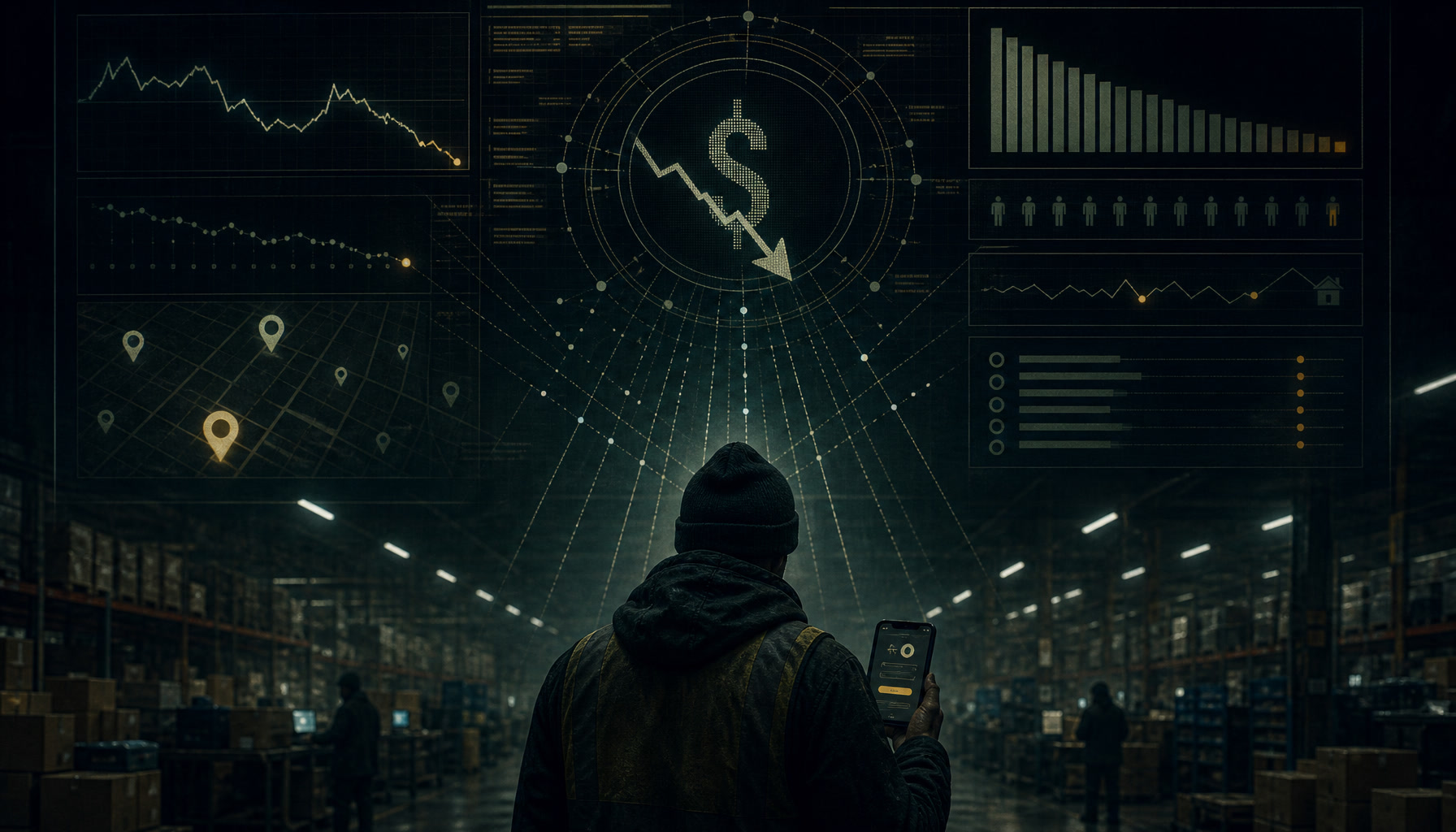
When AI learns exactly how little you will accept
We are used to algorithms deciding what we pay.
The flight is more expensive because everyone wants to travel that weekend. The Uber costs more because it is raining. The hotel room doubles because there is a concert nearby. The rent goes up because some software told the landlord the market could bear it.
We have been trained to call this dynamic pricing.
That phrase does a lot of work.
It makes the whole thing sound technical. Neutral. Like the price is responding to weather or traffic or supply and demand in some clean mathematical way. As if the algorithm is just reading the world and reporting back.
But the algorithm is not reading the world.
It is testing it.
It is asking: how much pain can this person absorb before they say no?
And now employers are starting to ask the same question about wages.
Not what is this work worth? Not what does this person need to live? Not what would be fair compensation for the time, skill, risk, and exhaustion required?
Just: what is the lowest number we can put in front of them and still get them to click accept?
That number has a name now. The “desperation wage.”1
It is one of the most honest phrases I have seen in years.
The auction for your own survival
Bloomberg Law reported that state lawmakers in the US are already looking at bills to regulate AI systems that tell companies how much to pay workers. The concern is not hypothetical. Vendors are offering automated wage-setting tools for health care, customer service, delivery logistics, manufacturing, and other sectors.1
The model is familiar because we have already seen it in gig work.
Uber was the prototype. Not just for transport, but for a whole way of managing labour. Workers log into an app. The app tells them what work is available, what it will pay, and when the rules have changed. It collects the data the whole time. The worker is technically free to refuse, in the same way a person drowning is technically free to refuse a rope.
That model is now spreading.
Nurses picking up shifts through gig apps. Delivery drivers chasing jobs across platforms. Contractors refreshing screens, waiting for a rate they can survive on. Workers being turned into bidders in an auction where the prize is being underpaid.
And the company gets to pretend this is freedom.
You choose your hours. You choose your shifts. You choose whether to accept the offer.
But choice under desperation is not the same thing as freedom.
If your rent is due, if your kid needs medicine, if your car registration is about to expire, if you are one missed shift away from the whole fragile structure collapsing, then the algorithm does not need to force you.
It only needs to know you.
Your location. Your work history. Your acceptance rate. Your past refusals. Your commute distance. Your home address. Whether you have children. Whether you usually accept lower rates near the end of the month. Whether you take worse offers when your account balance is low, or when there are fewer shifts left, or when the weather is bad, or when every other worker in your area has already logged off.
The point is not to calculate the value of labour.
The point is to calculate the breaking point of the labourer.
We have seen this machine before
The official story will be efficiency.
Companies will say AI helps them respond to market conditions. They will say it matches supply and demand, reduces administrative overhead, and lets pay rise when demand is high.
And sometimes it will.
That is how the hook works.
Surge pricing always comes with the fantasy that you might be the one who benefits from the surge. The driver who logs in at the perfect moment. The nurse who grabs the high-paying shift. The contractor who catches the platform when it is desperate.
But at a systemic level, the house always wins.
The platform sees the whole board. The worker sees one offer at a time.
Behind that single offer is everything the worker cannot see: how many other people are available, how low similar workers have accepted before, how urgent the shift really is, how much the company can afford, and how many offers can be tested across the market before anyone realises they are part of an experiment.
That is not a market.
That is a casino where only one side can see the cards.
When algorithms set consumer prices, we already know where this goes. The Department of Justice sued RealPage, alleging that its rent-pricing software allowed competing landlords to share sensitive data and coordinate rental prices through an algorithm. The software recommended rents based on information from rival landlords, and the DOJ alleged it helped maximise price increases and reduce competition.2
That is price fixing with a software layer.
The landlords do not need to meet in a smoky room. They do not need to write emails saying, “Let us all raise rents together.” They just feed their data into the same machine, follow its recommendations, and call the result optimisation.
The old cartel had to trust each other.
The new cartel trusts the dashboard.
Now apply that to wages.
If every major employer in a sector uses the same wage-setting tool, trained on the same market data, producing the same recommendations, what happens to pay?
Do we really think the machine will bid wages up out of moral concern?
Or will it do what every other pricing algorithm has been built to do: find the number that benefits the buyer?
In the labour market, the employer is the buyer.
The thing being bought is your life, one hour at a time.
The violence we are allowed to name
There is a strange asymmetry in how we talk about violence.
If a worker destroys property, everyone knows what to call it. Violence. Crime. Disorder. A threat to public safety. The story becomes legible immediately because capital has a language for harm done to capital.
A warehouse burns. A shopfront is smashed. A delivery van is torched. A machine is broken.
Violence.
But a company worth billions can pay an essential worker less than it costs to live in the city where the work exists, and the language suddenly softens into compensation strategy.
Staffing can be cut so thin that one person is left alone in a warehouse, responsible for the load that used to be carried by a team, and that becomes productivity.
A job can be essential enough that the company collapses without it, while the worker doing it still cannot afford rent, food, transport, medical care, or rest. Somehow, this is treated as the labour market.
Then a machine studies that worker’s desperation and learns, dollar by dollar, exactly how little they will accept.
Apparently, that is innovation.
This is the trick. Capital has narrowed the definition of violence until only damage to property counts. A broken window is violence. A burned warehouse is violence. A smashed machine is violence.
Poverty wages, exhaustion, deliberate understaffing, and forcing desperate people to compete for shifts that still do not cover their bills are treated as background conditions. Having your private life scraped for signals of how cheaply you can be bought is not violence in the official vocabulary. It is business intelligence.
But it is violence.
It is slower than fire. It is quieter than broken glass. It happens through payroll systems and scheduling software and contractor classifications and cheerful app notifications. It arrives as a number on a screen.
$18.40 for the shift.
Accept or decline.
No one raises a fist. No one gives an order out loud. No manager has to look you in the eye and say, “We know you cannot live on this, but we also know you will take it.”
The machine says it for them.
The boss without a face
This is why algorithmic wage-setting is so dangerous.
It does not just lower wages. It dissolves responsibility.
If a manager offers insulting pay, there is at least a person in the chain. Someone made the decision. Someone can be challenged, embarrassed, pressured, named.
But when the app offers the rate, where do you point the anger?
The company says the algorithm calculated it. The vendor says the employer configured it. The employer says the market produced it. And the market says nothing, because the market is not a person. It is the name we give to decisions powerful people would rather not defend.
This is the same move capital always makes when it wants cruelty without accountability. Build a system. Hide behind the system. Treat the output as neutral because the violence has been laundered through a process.
A human being says, “pay them less,” and it sounds cruel.
A machine says, “recommended compensation adjustment,” and suddenly everyone is discussing compliance frameworks.
Sound familiar?
Taylorism did this to factory work. Watch the worker. Time the worker. Break the job into motions. Remove judgment from the person doing the work and transfer it into the process owned by management.
AI wage-setting is Taylorism turned inward.
It does not only measure how fast you work. It measures how cheaply you can be made to work. It takes the messy human reality of survival and converts it into a pricing signal.
Your desperation becomes data.
Your bills become leverage.
Your need to eat becomes an input variable.
Personalised poverty
The most disturbing part is the possibility of personalisation.
We already understand personalised pricing as consumers. People have worried for years about whether apps could charge different prices based on device, location, browsing history, loyalty, urgency, or even battery level. Whether every specific story is true almost does not matter anymore. The fear itself reveals the relationship.
We know the machine is not on our side.
We know it is looking for weakness.
If a platform can charge more when it thinks you are desperate to get home, what stops an employer from paying less when it thinks you are desperate to work?
That is the line policymakers are now circling. Bloomberg reported that proposed bills have tried to bar companies from using personal data unrelated to work when setting pay. Data like biometric characteristics, parenthood status, behaviour patterns, weight, and home address.1
Think about how insane that is.
We have reached the point where lawmakers have to specify that your employer should not use your parenthood status or home address to calculate how little to pay you.
Not because everyone agrees this is obviously monstrous.
Because the technology makes it possible, and if it is possible, someone will try to sell it as a service.
That is the pattern.
First they collect the data. Then they say the data improves efficiency. Then refusing to use the data becomes a competitive disadvantage. Eventually the practice becomes normal, and anyone objecting is told they do not understand the future.
The framing changes. The pattern does not.
This is not an accident
We should be very clear about what these systems are for.
They are not built to ask what a dignified wage is, what it costs to live near the workplace, or whether a nurse should have to gamble on shift rates after spending years training for a job society claims to respect. The question of whether an essential worker can afford shelter never enters the model.
They are built to optimise labour cost.
Labour cost means wages.
Wages mean rent, food, medicine, transport, school shoes, electricity bills, dental work postponed for another year, the difference between taking a sick day and going in contagious because you cannot afford not to.
When companies say they are reducing labour costs, they are saying they are taking money from the people who do the work.
AI does not change that moral fact.
It only makes the extraction faster, more granular, and harder to see.
The old boss might underpay everyone equally because he only had blunt instruments. The new boss can underpay each person precisely. Not just by role. Not just by region. By vulnerability.
One worker gets offered less because they usually accept. Another because they live nearby. Another because they have not worked in ten days. Another because the system has learned they take bad shifts when childcare patterns suggest they are available.
This is not science fiction. This is the obvious destination of a business model that combines wage suppression, surveillance, and machine learning.
If you give capital a tool that can calculate the minimum a person will tolerate, capital will use it to push that minimum lower.
Why wouldn’t it?
The entire system rewards it.
The market does not become fair because a robot did the maths
There will be people who argue that this is just supply and demand.
If too many workers are available, wages fall. If too few workers are available, wages rise. The algorithm is just making the market more efficient.
But labour is not a normal commodity.
A worker cannot withhold their labour indefinitely while waiting for a better price. A landlord can leave an apartment empty. A company can delay a project. An investor can sit on cash.
A worker has to eat.
That changes everything.
The negotiation between employer and worker already begins with an imbalance. One side is deciding how much profit it would like to keep. The other side is deciding how long they can survive.
Algorithmic wage-setting does not correct that imbalance. It exploits it.
It gives the stronger party better information about the weaker party’s breaking point. It lets employers coordinate without looking like they are coordinating. It lets companies personalise low pay while pretending the number came from the market.
This is not a free market becoming more efficient.
This is power becoming more precise.
What kind of society lets the machine make the offer?
The danger of AI wage-setting is not only that some workers might be paid unfairly, though they will be.
The danger is that we are building a world where survival itself becomes dynamically priced.
Rent already moves this way. Transport moves this way. Food delivery moves this way. Insurance moves this way. Ticketing moves this way. Every part of life is being surrounded by systems designed to calculate what desperation is worth.
Now wages are being pulled into the same machinery.
The price of what you need goes up because the algorithm knows you need it.
The price of what you sell goes down because the algorithm knows you are desperate to sell it.
That is the trap.
Capital gets surge pricing when you buy.
Capital gets desperation pricing when you work.
Higher prices on the way in. Lower wages on the way out. The machine squeezes from both sides and calls the result optimisation.
And when people finally break under that pressure, when they lash out, when they burn something, smash something, refuse something, block something, the whole moral vocabulary of society comes alive to condemn them.
Violence against capital is named immediately.
Violence against workers is processed as a business expense.
We need to reject that framing before it hardens into common sense.
A wage is not just a number. It is a claim about what someone’s life is allowed to be. It decides whether they rest or collapse. Whether they live near their work or commute for hours. Whether they see a doctor. Whether they can leave a bad relationship. Whether they can say no.
Letting AI calculate the lowest wage someone will accept is not innovation.
It is automated coercion.
It is a machine trained to ask how close to the edge a person can stand before they fall.
The question is not whether the algorithm is accurate.
The question is why we are building systems that measure human desperation so capital can buy it at a discount.